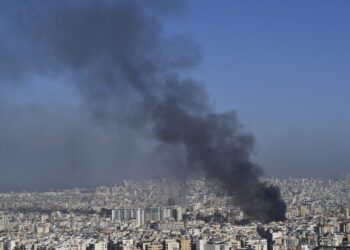


The gathering said the assault in northern Israel was in reprisal for the death of senior administrator Taleb Abdullah – known as Abu Taleb – in an Israeli air attack in the southern Lebanese town of Jouaiya recently. The source said the “compound assault” likewise meant to lay out discouragement after the killing of Abdullah.
According to the source, the Lebanese group targeted 15 Israeli positions, including some in the occupied Golan Heights, with 150 rockets and 30 explosive drones.
According to Israeli media, fifteen fires were started and at least two people were injured by Hezbollah rockets. In a post on X, the Israeli military claimed that “numerous” launches had been intercepted and that some had set fires ablaze.
The operation was carried out “in support of the steadfast Palestinian people and their courageous and honorable resistance in Gaza and in the context of the response to the assassination that the Zionist enemy carried out in Jouaiyya,” according to an official statement issued by Hezbollah. Hezbollah claimed that one of the Israeli units targeted by the attack is in charge of planning assassinations.
On Wednesday, Hezbollah had likewise terminated a torrent of 200 rockets at Israel. Since Abdullah and three other fighters were killed late on Tuesday, rocket sirens have been heard in northern Israel almost constantly. Abdullah was only the second slain fighter from Hezbollah to be praised as a “commander” in the past few months, following Wissam al-Tawil, who was killed in an Israeli attack in January. Hezbollah does not disclose details about its military structure or ranks.
Hamas and the Palestinian Islamic Jihad honored Abdullah on Wednesday, praising his endeavors to stand up to Israel. After the war in Gaza started, Hezbollah started attacking military bases in northern Israel as what it calls a “support front” to support Palestinian armed groups. Israel has responded by bombing Hezbollah positions and villages throughout south Lebanon.
Contrasts have largely been contained to the border region, despite the nearly daily firefights. To escape the violence, tens of thousands of people have fled their homes in south Lebanon and northern Israel. Hassan Nasrallah, the head of Hezbollah, portrayed the Lebanese front with Israel as historically decisive late last month. “This fight concerns Palestine, yet additionally concerns the fate of Lebanon and its water and oil assets,” Nasrallah said.
“This front is a help front that is essential for the fight that will decide the destiny of Palestine, Lebanon and the district in an intelligent way.” The Lebanese organization has strengthened over the past few years with Iran’s assistance.
The war that Hezbollah waged against Israel lasted for many years and culminated in the Israeli troops’ departure from portions of south Lebanon that they had occupied for nearly two decades. After the group carried out a deadly cross-border attack against Israeli forces in 2006, Israel launched a significant offensive to disarm Hezbollah.
The contention finished without significant changes to the state of affairs. However, since then, Hezbollah has increased both its regional influence and its rocket arsenal. Recently, Hezbollah vice president Sheik Naim Qassem told Al Jazeera that the gathering is “prepared” for war assuming Israel strengthens its assaults.
He stated that “devastation, destruction, and displacement in Israel will be met with any Israeli expansion of the war on Lebanon.” “We are prepared for an all-out war if Israel wants to fight it,” Hezbollah fighters will be pushed further away from Israel’s borders, including by force, according to Israeli officials.
David Mencer, a spokesman for the Israeli government, stated on Thursday that “Israel will respond with force to all aggressions by Hezbollah.” “Israel will restore security on our northern border, through diplomatic efforts or otherwise,” A conflict with Hezbollah, which has exhibited complex military capacities, including the utilization of directed rockets and accuracy drones, could demonstrate more exorbitant to Israel than the proceeding with struggle in Gaza.
Zeina Khodr of Al Jazeera reported from Beirut that Hezbollah has been intensifying its attacks in response to the death of its commander, strengthen Hamas’ negotiating position during ceasefire talks, and warn Israel against launching a major offensive in Lebanon. Khodr stated, “So this is also about Hezbollah’s deterrence.” In reference to the Israeli promise to respond to the most recent attacks, he stated, “No doubt, this is a dangerous escalation of this ongoing conflict.”