


Researchers consider it the Doomsday glacier. That is somewhat on the grounds that the Thwaites, a Britain-sized glacier in western Antarctica, is liquefying at a disturbing rate. It’s withdrawing by about a large portion of a mile (2,625 feet) every year. Researchers gauge the glacier will lose the entirety of its ice in around 200 to 600 years. At the point when it does, it will raise ocean levels by about 1.6-2 feet (0.5 meters).
The Glacier Is Melting Rapidly
Be that as it may, the ocean level ascent wouldn’t stop there. Thwaites’ epithet stems generally from what might occur after it liquefies. At the present time, the glacier goes about as a cradle between the warming ocean and different glaciers. Its breakdown could bring neighboring ice masses in western Antarctica down with it. Included, that cycle would raise ocean levels by almost 10 feet, for all time lowering numerous waterfront zones including portions of New York City, Miami, and the Netherlands.
“It’s a significant change, a revamping of the coastline,” David Holland, a teacher of climatic science at New York University who contributes exploration to the International Thwaites Glacier Collaboration, told PBS NewsHour in February. This moth, two new investigations have added detail to the disturbing picture. Exploration distributed a week ago in the diary Cryosphere found that warm sea flows might be consuming the Thwaites Glacier’s underside.
An examination distributed Monday, in the interim, utilized satellite symbolism to show that segments of Thwaites and its neighbor, the Pine Island Glacier, are breaking separated more rapidly than recently suspected. The pictures underneath uncover what’s befalling the Thwaites and close by glaciers, alongside what could occur later on. The softening of the Thwaites and Pine Island Glaciers as of now represent around 5 percent ocean level ascent.
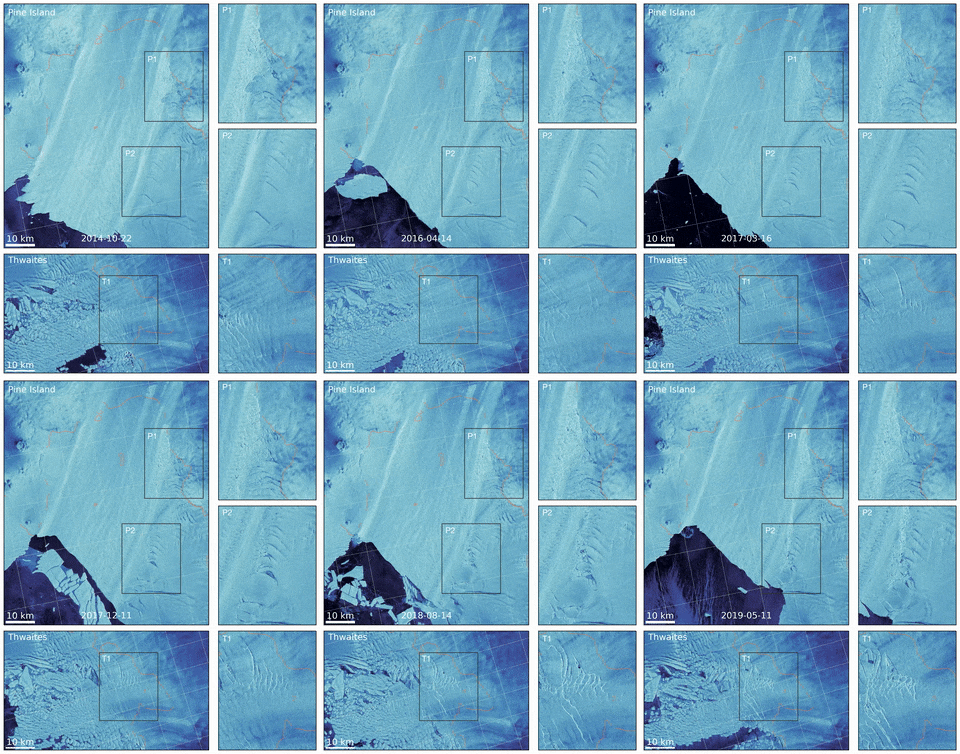
Above: Satellite symbolism between October 2014 and May 2019 shows broad harm to the Thwaites and Pine Island Glaciers. It’s not simply the Thwaites: The Antarctic ice sheet is liquefying multiple times quicker than it was during the 1980s. It’s shedding 252 billion tons every year, up from 40 billion tons for each year 40 years back.
Doomsday Will Be Real If It Melts Completely
In the event that the whole Antarctic ice sheet liquefied, researchers gauge ocean levels would ascend by 200 feet. When pictures taken from space show the Thwaites glacier dissolving into the ocean. “What the satellites are indicating us is a glacier breaking apart,” Ted Scambos, a senior researcher at the University of Colorado, told NASA in February. This quick liquefying is going on to a limited extent since regular cradles holding the Thwaites and Pine Glaciers set up are breaking separated. Precipices like those in the picture of Pine Island Glacier above structure close to glaciers’ shear edges.
 The new PNAS study found that shear edges on the Pine Island and Thwaites Glaciers are debilitating and breaking separated. It could make ice stream into the sea. The approaching loss of the Thwaites Glacier is troubling to such an extent that the US and UK made a worldwide office to examine it. That association, the International Thwaites Glacier Collaboration, examines the glacier by means of icebreaker sends that can get through thick ice sheets.
In February, specialists found a cavity almost the size of Manhattan on the underside of Thwaites. Specialists determined that the Pine Island Glacier has lost a zone the size of Los Angeles over the most recent six years. “These are the primary signs we see that Pine Island ice rack is vanishing,” Stef Lhermitte, a satellite master and lead creator on the PNAS study, told the Washington Post. This harm is hard to mend. Ocean level ascent could influence upwards of 800 million individuals by 2050, as per a 2018 report.