


Envision you could toss the ideal bullseye, yet you’d need to wear glasses to do it. That is a compromise some space explorers may accidentally make when they adventure off the planet. An investigation distributed Friday inspected the minds of eight male Russian cosmonauts about seven months after they came back from long missions to the International Space Station.
The scientists found minor changes in the cosmonauts’ minds. It recommended the men were more skillful. However they had marginally more fragile vision. The specialists utilized a sort of MRI to deliver 3D pictures of the cosmonauts’ cerebrums. The sweeps indicated an expanded measure of tissue in the cerebellum: the aspect of the cerebrum answerable for parity, coordination, and stance (appeared in green in the video beneath).
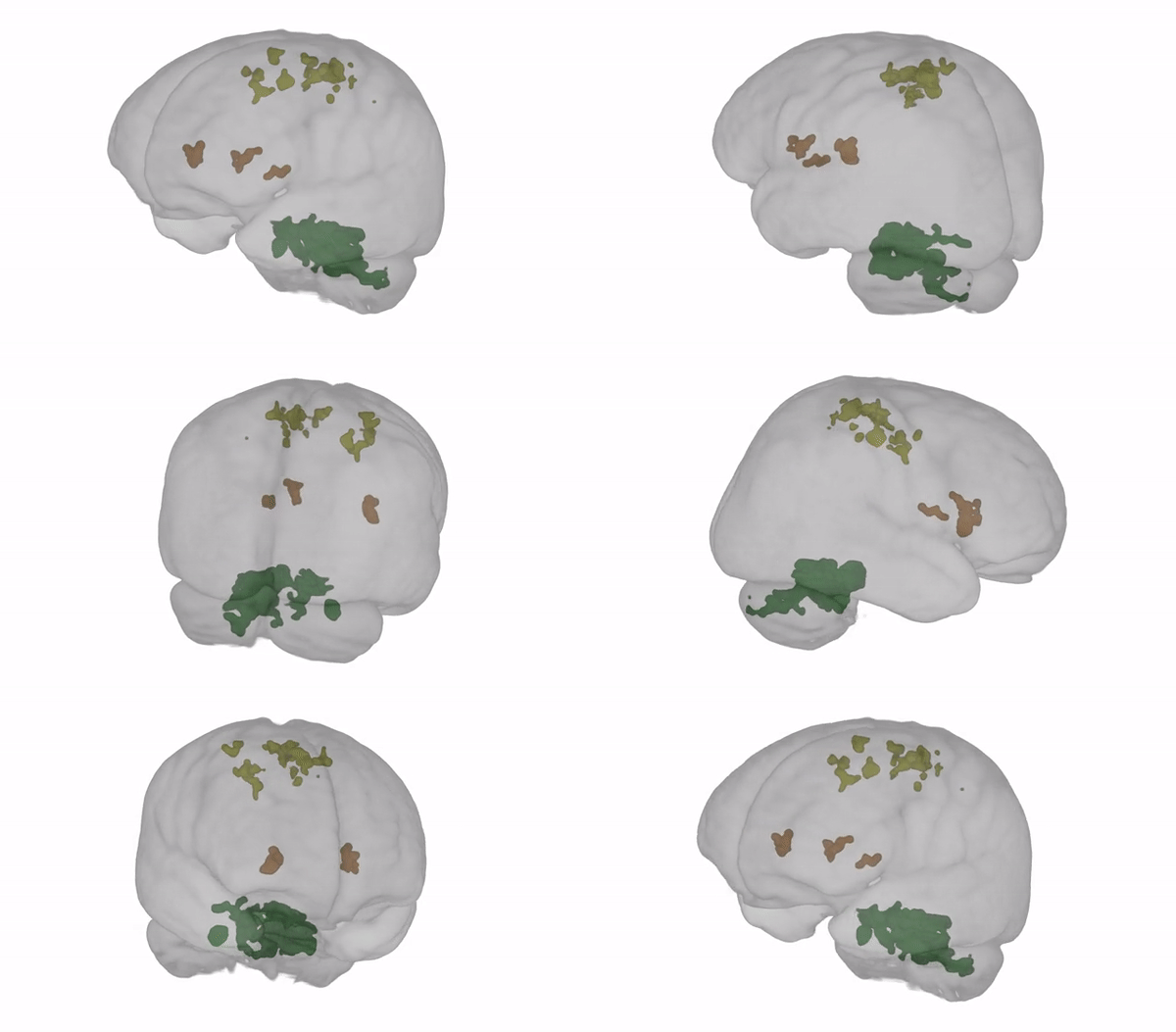 Yet, the outputs likewise indicated that individuals living in space could end up with inconvenience seeing very close. Both of those progressions might be enduring.
Changes in Motor Skills and Minds after space travel
Any human mind, regardless of whether it has been to space or not, can adjust to new conditions and encounters. Numerous competitors, for example, get explicit engine abilities legitimately identified with their game. “If you somehow happened to do a MRI study where you contrast ordinary individuals with competitors or individuals who truly utilize engine aptitudes like dart players, for instance, you would estimate to discover changes in the cerebellum,” Jillings said.
By and large, the Russian cosmonauts in the examination went through a half year installed the space station. Specialists expected to see transitory changes in the cosmonauts’ mind, yet they were shocked to find that the improved engine aptitudes were still there a while after they’d came back to Earth.
Brain moves in space, bringing about obscured vision
Numerous past investigations have uncovered that space explorers experience physical changes in microgravity, including muscle and bone misfortune. Space explorers and cosmonauts on the ISS commonly practice over two hours every day to battle this cycle. They can likewise feel bewildered or movement debilitated while their body acclimates to a weightless situation.
One significant contrast between life in space and on Earth is that our blood and organic liquids ordinarily move against the descending pull of gravity, though in space, space travelers’ natural liquids move upward. The new examination found that microgravity makes the cerebrum move upward also. This thus redistributes the liquids wherein the cerebrum skims. Jillings said his investigation discovered proof that the liquid may accumulate behind the eye, causing expanding. This could impede space explorers’ close to vision, bringing about a condition called spaceflight-related neuro-visual disorder.
 A 2012 study found similar impact among numerous NASA space explorers – up to 60 percent of those contemplated said they were seeing less plainly locally available the ISS. NASA even flies solution glasses to space just on the off chance that a space traveler’s vision changes. Yet, Jillings said there’s still more to find out about this wonder. It is particularly on the grounds that not all space explorers or cosmonauts come back to Earth with awful vision. Most space travelers concentrated just created hindered vision in one eye. Some additionally recuperate their vision soon after coming back to Earth.
Likewise, numerous Russian cosmonauts have very sharp sight in the first place. So even after they complete a stretch in space, their vision is as yet ordinary contrasted with the normal individual. Past examinations, paradoxically, have recommended that radiation in space could prompt neuro-degeneration, which may quicken the improvement of Alzheimer’s infection among space explorers.