


The idea of freezing particles by warming them is counterintuitive, to say the least. But physicists have shown how specially designed mixtures ‘melt’ in the dark. But they also crystallise the moment the lights come on, thanks to their unique thermal activity.
What Was Done In The Study..??
Researchers from the University of Cambridge in the UK carried out their experiments on a colloid made up of water, polystyrene and small droplets of oil. The oil was coated in DNA to better understand the dynamics taking place between them when warmed by light.
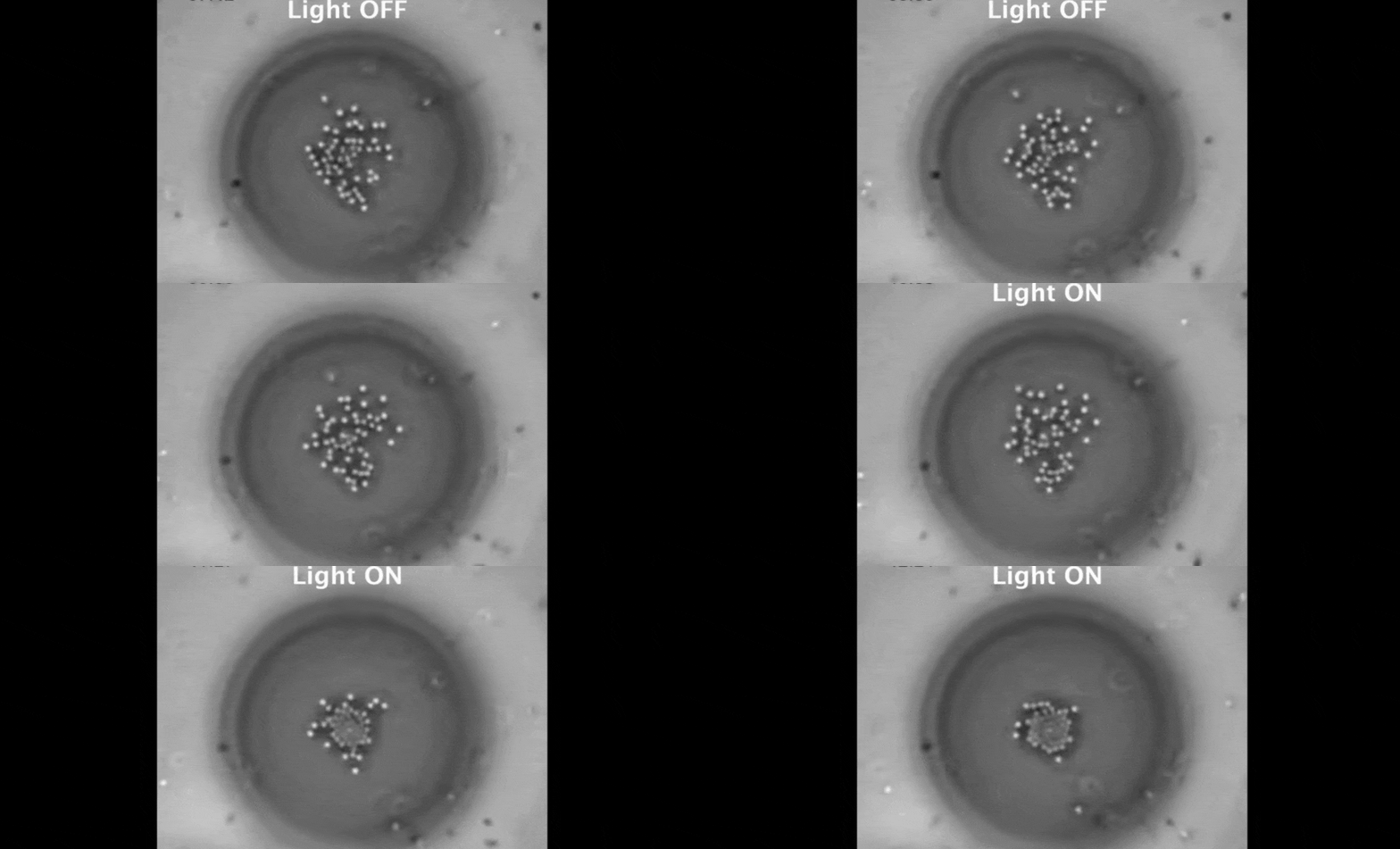
So it’d stand to reason that if we heated suspensions of oil, focussing on the boundary with its watery surrounds, you would expect the mix of molecules to jiggle with excitement, bumping and grinding their way towards cooler areas and causing the fluids to move.
There’s even a term for this oil and water flow; the Marangoni effect. Simply, the contrasting surface tension between oil and water makes each susceptible to variations in temperature forcing their particles to scatter.
Findings Of The Study
To study the effect light has on suspensions of droplets, soft matter physicist Alessio Caciagli and his team coated 20-30 microns-wide blobs of oil in a polymer. It was heavily dusted with single strands of DNA.
These fuzzy oil balls were then combined in a suspension with polystyrene spheres roughly half a micrometre in diameter. The DNA connected the polystyrene to the outer surface of the oil drops. So when the material was suspended in water it formed a loosely bound colloid. Then the real fun began. Shining a light on the interface between the oil and the water caused a single polystyrene clump to sit in place. It was gripped by well understood optical effects.
Basking in the laser’s glow, the polystyrene’s temperature rose by about 5 degrees Celsius. It set up a heat gradient against the surrounding water. Ordinarily the Marangoni effect should be enough to scatter the polystyrene spheres and send the colloid flying apart. But tethered together by a hazy mesh of DNA strands, the polystyrene instead drifted closer.
It turns out, the heat gradient produced by the trapped polystyrene creates flow in the two liquids that suck the other suspended particles in close.