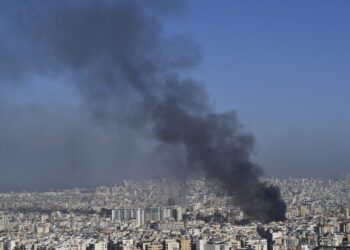


The health minister of Lebanon reports that nine people, including a toddler, have died as a result of the country’s handheld pagers, which were used by Hezbollah members as a means of communication, exploding all over the place.
Among the 2,800 people injured by the coordinated explosions in Beirut and numerous other areas was Iran’s ambassador to Lebanon.
Iran-backed Hezbollah confirmed the deaths of eight fighters and said the pagers belonged “to personnel of various Hezbollah units and institutions.”
The organization promised to exact “fair punishment” on Israel for what it described as “this heinous aggression.” The Israeli military remained silent on the matter.A few hours prior to the blasts, the Israeli security cabinet declared that one of the official war objectives was to halt Hezbollah’s attacks in the country’s north so that displaced citizens could return safely.
Since the day following the beginning of Israel’s conflict with Hamas in Gaza on October 7, there have been nearly daily gunfire exchanges over the Israel-Lebanon border.
Hezbollah has declared its support for the Palestinian organization funded by Iran.
Hezbollah announced on Wednesday that it would continue its “operations in support of Gaza” and described this as a “continuous road apart from the terrible price that awaits the enemy in reaction to its atrocity on Tuesday.” This was the group’s most recent statement.
Both Hezbollah and Hamas are proscribed as terrorist organisations by Israel, the UK and other countries.
The UN’s spokesman said the latest developments in Lebanon were “extremely concerning, especially given that this is taking place within a context that is extremely volatile”.
Many Lebanese were in a state of shock and disbelief on Tuesday evening, unable to get their heads around an event that was unprecedented in scale and nature.
Hezbollah said an unspecified number of pagers – which the group relies on heavily for communications due to the risk of mobile phones being hacked or tracked – exploded at around 15:30 local time (12:30 GMT) in the capital Beirut and many other areas.
One CCTV video showed an explosion in a man’s bag or pocket at a supermarket. He is then seen falling backwards to the ground and crying out in pain as other shoppers run for cover.
Hours later, ambulances were still rushing to hospitals overwhelmed with the number of casualties, 200 of whom the health minister said were in a critical condition. Outside, relatives were waiting in the hope of receiving updates.
The LAU Medical Centre in Beirut’s Ashrafieh district closed its main gate and was limiting the number of people getting in. “It’s very sensitive and some scenes are horrific,” one staff member told the BBC.
Most of the wounds were at the level of the waist, face, eyes and hands, he said, adding: “A lot of casualties have lost fingers, in some cases all of them.”
The wife of Iranian ambassador Mojtaba Amani said he was “slightly injured” by one of the explosions and that he was “doing well” in