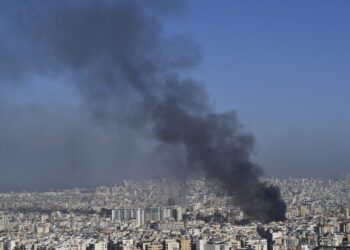


In an airstrike on a Beirut suburb, Israel strikes the senior Hezbollah leader, resulting in 14 fatalities and 66 injuries.
Israel launched an attack on a residential neighborhood in the southern suburbs of Beirut, the capital of Lebanon, in an effort to kill Ibrahim Aqil, a top Hezbollah commander.
Hours after the Israeli military declared it had “eliminated” Aqil in the assault on the Dahiyeh neighborhood, Hezbollah confirmed Aqil’s death on Friday.According to a preliminary toll, the incident left at least 14 persons dead and 66 injured, according to Lebanon’s Ministry of Public Health.
At least two buildings were destroyed by the Israeli bombardment while Aqil, a top official in Hezbollah’s elite Radwan Force who has a $7 million bounty on his head from the US Department of State, was allegedly attending a joint meeting between Hezbollah and an unidentified Palestinian entity.
As Lebanese Civil Defence forces excavated in search of survivors, witness film revealed piles of gray rubble where one structure previously stood and heavy dust spilling into the roadway and covering parked automobiles.
Following an unprecedented attack earlier this week in which the group’s members’ pagers and walkie-talkies detonated, killing 37 and injuring hundreds, the attack dealt Hezbollah even another blow.
It was Israel’s second attack on a senior Hezbollah military commander in Beirut in less than two months. The group’s senior military commander, Fuad Shukr, was killed in July by an Israeli airstrike.
Killing Hezbollah’s second-in-command, Aqil, would deal the organization even another severe blow.
The Israeli military claims that Aqil, who joined Hezbollah in the 1980s, was in charge of the organization’s activities outside of Lebanon.
Aqil, like the majority of prominent Hezbollah military figures, has remained anonymous and has not made any public appearances or pronouncements.
Aqil, also referred to as Tahsin, was a member of Hezbollah’s top military body, according to US sources.
Due to his involvement in the 1983 bombings of the US Marine Corps barracks in Lebanon, which claimed the lives of 241 US Marines, and the US Embassy in Beirut, which killed 63 people, he was wanted in the US.
Aqil was a prominent member of the Hezbollah cell known as the Islamic Jihad Organization, which claimed responsibility for the attacks.
US officials claim that Aqil oversaw the 1980s capture of German and American hostages.
Leading the Hezbollah-Israeli cross-border combatants is the Radwan Force.
According to Israeli daily Haaretz, Aqil was hurt during the Tuesday pager explosions and was released from the hospital earlier on Friday.